
Criminal Cases in the Donley County Courts
Donley County criminal cases split by charge level. The 100th Judicial District Court is the felony trial court. The constitutional county court handles county-level criminal jurisdiction assigned by Texas law. Both sets of filings are held by the combined Donley County and District Clerk at the county courthouse. That shared office makes one contact point useful, but it does not merge the two courts or their dockets.
Fine-only misdemeanor and traffic files remain elsewhere. Justice Court Precincts 1 and 2 keep their records in Clarendon, while Precincts 3 and 4 keep county justice-court records in Hedley. Clarendon Municipal Court has its own fine-only lane. A name may therefore occur in more than one Donley County court record system. Start with the alleged charge and location, then ask the clerk to confirm the correct venue.
The 100th Judicial District also serves Carson, Childress, Collingsworth, and Hall Counties. A district-wide judge or prosecutor contact does not change the record custodian for a case filed in Donley County. The clerk's official Donley County district page remains the source for the local charging instrument, docket, judgment, and sentence.
Donley County Court Case Lanes
The court name tells a reader what kind of Donley County case file to seek. A felony filing belongs in district court. A Class A or B misdemeanor generally points to the county court. A fine-only charge may sit with a justice court or, when it arose under Clarendon jurisdiction, with the municipal court. The court that took payment is not always the court that holds a related arrest or higher-level prosecution.
| Court | Criminal role | Record contact |
|---|---|---|
| 100th Judicial District Court | Felony cases | Combined clerk, (806) 874-3436 |
| Donley County Court | Assigned county-level misdemeanors | Combined clerk, (806) 874-3436 |
| JP Precincts 1 and 2 | Fine-only and traffic matters | (806) 874-2016 |
| JP Precincts 3 and 4 | Fine-only and traffic matters | (806) 856-5914 |
| Clarendon Municipal Court | City fine-only and ordinance matters | Municipal court records channel |
When the charge level is uncertain, ask the combined clerk to search both Donley County indexes before moving to a justice or city court. That order reduces duplicate requests while preserving the separate court records.
How to Search Case Records
Texas does not provide a statewide public trial-court case search. The Office of Court Administration identifies iDocket as the Donley clerk's internal case-management system, but no official public Donley County search URL was verified. The Texas Judicial Branch directs searchers to the proper clerk. Use the following clerk-mediated path rather than treating a payment link as a complete docket.
- Choose district, county, justice, or municipal court from the charge level and location.
- Give the custodian the full legal name, approximate filing year, charge, and cause number if known.
- Ask the combined clerk to check both district and county indexes when the venue is uncertain.
- Request the docket, charging instrument, judgment, sentence, and any public bond or cost entries needed.
- Ask whether inspection, mail, email, or certified paper is available and request a cost estimate before ordering.
The fields below are request keys, not labels from an unverified public portal.
| Search detail | Format | Required | Why it helps |
|---|---|---|---|
| Full legal name | Text | Yes | Locates the party index |
| Approximate year | Year or range | No | Narrows current and archived files |
| Cause number | Court identifier | No | Points to one docket |
| Charge or case level | Description | No | Helps choose the proper court |
| Document requested | Description | Yes | Distinguishes inspection, copy, or certification |
Donley County Justice Court Records
Donley County has two justice-court contact routes, and neither should be confused with a city court. The official Texas court directory identifies the Clarendon and Hedley justice offices. The published payment channels serve ticket resolution, but research did not verify them as full history searches. Call the matching JP clerk when a fine-only docket does not appear through the combined clerk.
The official directory view below helps separate the two county offices. It does not turn either payment route into a complete Donley County criminal case database.
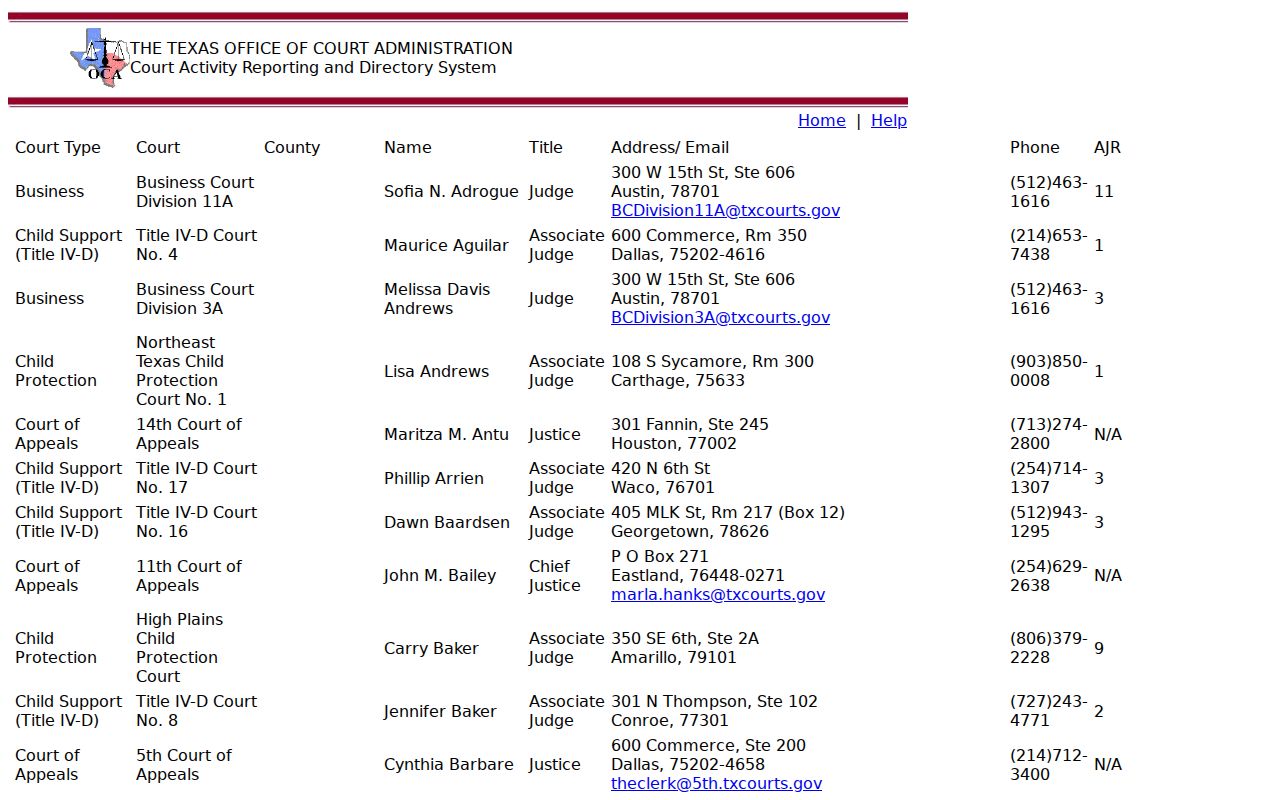
The Donley County justice-court page gives the direct local routes. For a Clarendon-area fine-only file, contact JP Precincts 1 and 2 at 309 South Sully, mailing P.O. Box 828, Clarendon, or call (806) 874-2016. For Precincts 3 and 4, use Main Street, mailing P.O. Box 62, Hedley, or call (806) 856-5914. Ask for the docket and disposition, not just the balance due.
What the Case File Shows
A Donley County criminal case file follows the formal prosecution. It is richer than a booking record because it can show the accusation actually filed, court settings, pleas, rulings, and the final judgment. No public sample case was available, so the exact local screen labels and cause-number pattern remain unverified. The inventory below describes the usual clerk-held items documented in the research.
| Cause Number and Court | Identifies the local case and the court with jurisdiction. |
|---|---|
| Charging Instrument | Shows the complaint, information, or indictment that states the filed allegation. |
| Docket Entries | Tracks filings, settings, appearances, motions, and orders in date order. |
| Plea and Verdict | Records the plea and any trial result. |
| Disposition and Judgment | Shows dismissal, acquittal, conviction, deferred adjudication, or another entered outcome. |
| Sentence and Conditions | May state custody, supervision, fines, costs, restitution, and related orders. |
For proof of an outcome, request the judgment or disposition itself. A docket is a useful event index, but a certified judgment is the stronger record for correcting a downstream state entry.
Reading Donley County Case Outcomes
The clerk's judgment is the controlling local source for a Donley County case outcome. A DPS entry is a downstream report. If the statewide record lists an arrest without a disposition, that gap does not prove the case is pending. DPS says an outcome can be missing because the report was not received or was returned for an error. A jail allegation, by contrast, is not yet a filed charge.
- Disposed
- An outcome has been entered in the case.
- Deferred adjudication
- The court defers a guilt finding while supervision terms apply.
- Dismissed
- The charge ended without a conviction.
- Acquitted
- A trial ended in a not-guilty result.
- No-billed
- The grand jury declined to return an indictment.
Compare the docket and judgment with any DPS cycle. When they conflict, obtain a certified disposition from the combined clerk. DPS requires a sealed or certified court record for its correction process, not an ordinary photocopy.
Stages of a Criminal Case
A Donley County court file grows in stages. After an arrest, Texas law generally requires magistration without needless delay and no later than 48 hours. Prosecutors may then file a complaint, information, or indictment as the charge and court require. Arraignment records the accusation and plea. Pretrial entries show settings, motions, and negotiated action. A plea or trial leads toward disposition, and a conviction leads to sentencing.
Case flow: Charges Filed › Arraignment › Pretrial › Plea or Trial › Disposition › Sentencing
Not every arrest completes that path. A prosecutor may decline or change an allegation. A charge may be dismissed, and a trial may end in acquittal. The Donley County arrest history explains why the earlier booking record remains a separate source.
Donley County Federal Case Records
Federal criminal cases arising from Donley County do not go into the combined county clerk's index. Donley is assigned to the Amarillo Division of the Northern District of Texas. Federal dockets are searched through PACER, which requires registration for remote access and shows docket entries, parties, filing dates, event text, and public filed documents.
The official PACER entry page pictured below marks the correct federal path. A missing county case search says nothing about whether a federal case exists.
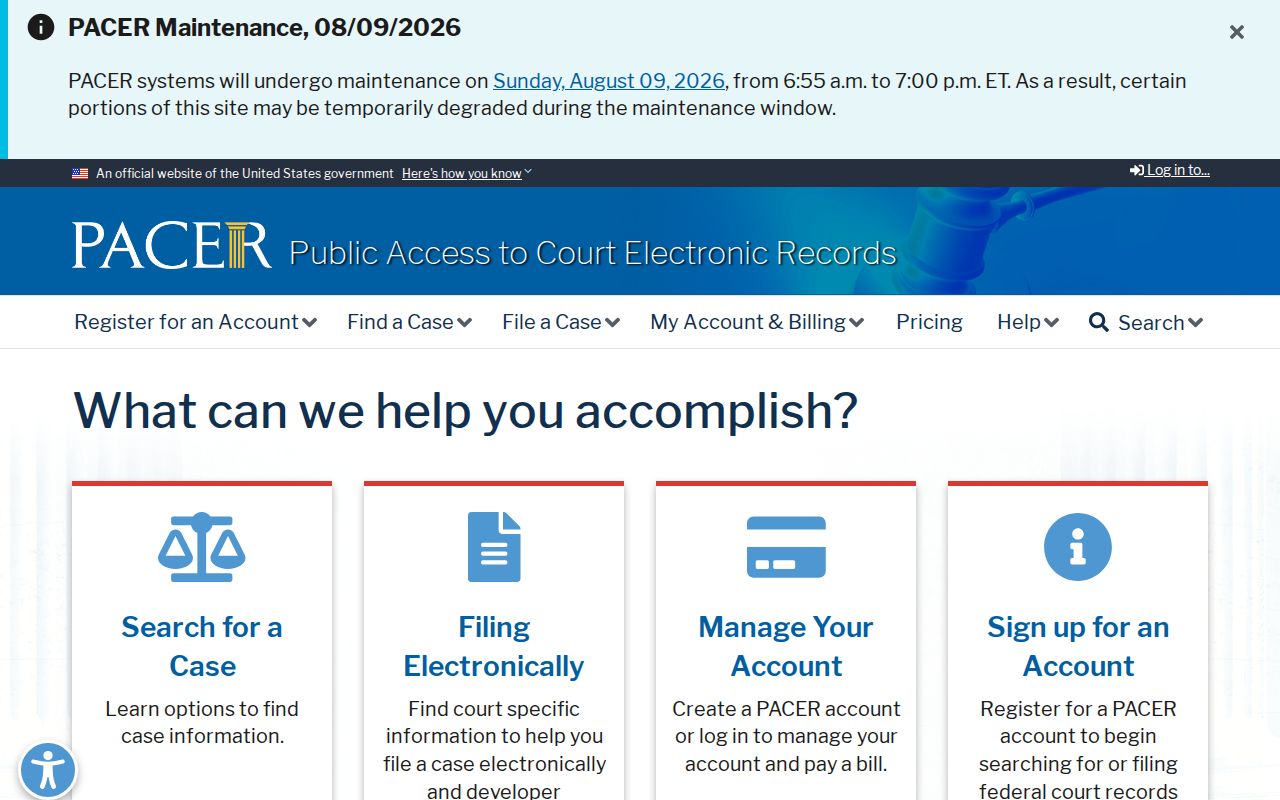
The federal layer matters only when jurisdiction is federal. County felonies remain with the 100th District Court, and local misdemeanor files remain with their Donley County or city custodian.
Access & Restrictions
Public access does not mean every field or every Donley County filing is open. Government Code section 552.021 supports access to public information, subject to confidentiality and exceptions. Filed case records are distinct from the non-adjudicative judicial records governed by Rule 12. Juvenile material, protected victim and minor data, sensitive identifiers, sealed matters, expunged records, and nondisclosed information can be withheld or redacted.
When a file does not appear, ask the custodian whether the cause is in another court, archived on paper or microfilm, stored off-site, or restricted by an order. The combined clerk accepts contact at 300 Sully Street, P.O. Drawer U, Clarendon, Texas 79226, by phone at (806) 874-3436, by fax at (806) 874-3351, or by email at doncoclerk@co.donley.tx.us. Posted counter hours are Monday through Thursday, 7:30 a.m. to noon and 1:00 to 4:45 p.m., and Friday, 7:30 a.m. to 1:00 p.m.
No criminal-copy fee, certification fee, search fee, online date range, update schedule, wildcard rule, result limit, or download policy was verified for Donley County. Ask for the current charge before ordering. If the request is broad, describe the public records sought and respond to any written estimate so the custodian can continue processing it.
Donley County Nondisclosure Case Files
Expunction and nondisclosure affect access in different ways. Expunction under Code of Criminal Procedure Chapter 55A removes qualifying arrest-related records as ordered. Nondisclosure restricts ordinary public release while leaving access for authorized entities. Eligibility depends on the exact charge, outcome, and history. A missing public result should never be read as proof of either form of relief.
The Office of Court Administration form library organizes model nondisclosure packets by Government Code section. Its official page is shown below.
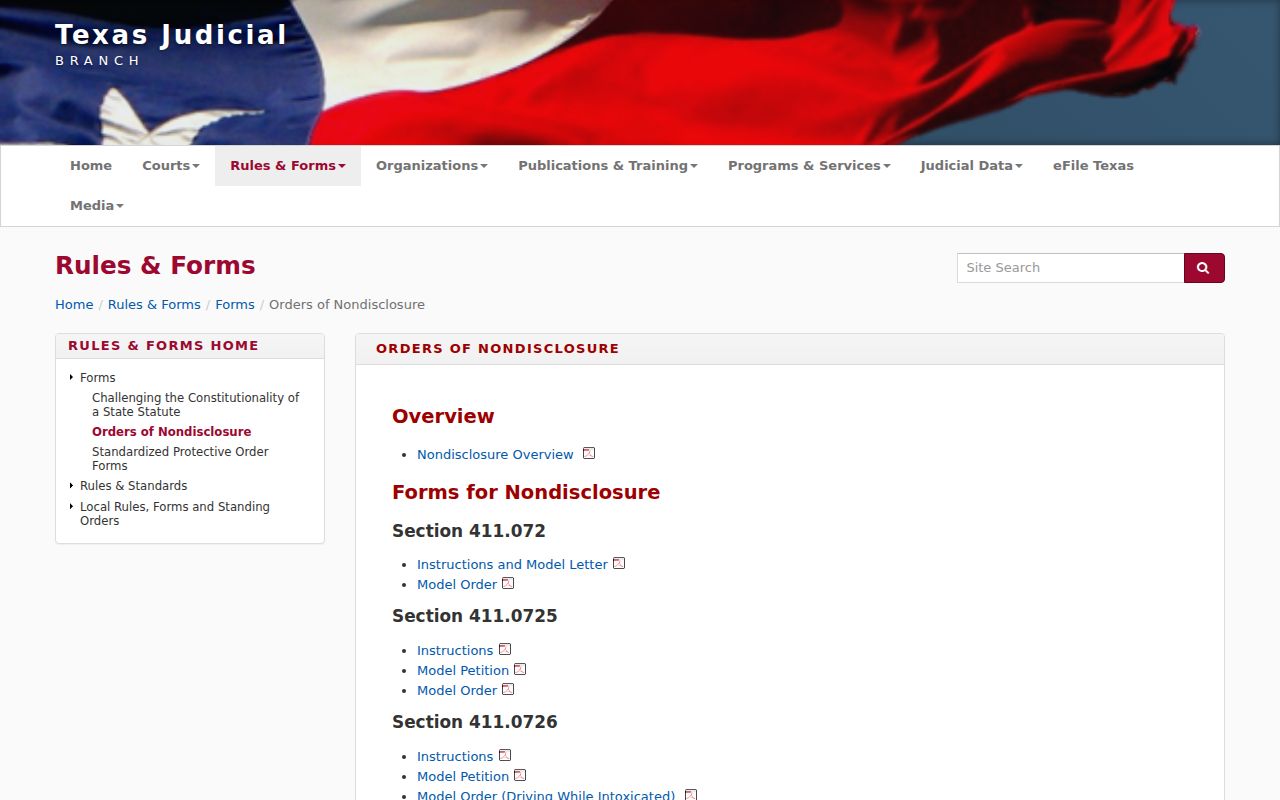
Choose a packet only after matching it to the actual Donley County judgment. The combined clerk can confirm the court, current filing method, local cover sheet, copies, and fee, but the research found no published Donley expunction fee or local petition form.